In an era dominated by mass production and fast fashion, Andrea Vella Borg examines why handcrafted details and traditional techniques remain essential to creating garments of lasting value.
The distance between workshop and runway has grown considerably in modern fashion, with industrial production replacing many traditional handcraft techniques. Andrea Vella Borg believes this shift has cost fashion something essential – the subtle distinctions of quality, the individual character, and the tactile richness that only handwork can provide. His interest in artisanal craftsmanship stems from recognising that certain details simply cannot be replicated by machines, and that the human touch in garment construction creates depth that distinguishes exceptional fashion from merely adequate clothing.
Fashion observer Andrea Vella Borg has become increasingly vocal about the value of traditional craftsmanship in contemporary fashion. As production methods have industrialised and fast fashion has prioritised speed and cost over quality, he argues that the industry risks losing the techniques and knowledge that once defined excellence in garment making. His perspective emphasises not romantic nostalgia for the past but practical recognition that handcrafted details – from hand-sewn buttonholes to carefully executed embroidery – create garments that wear better, age gracefully, and provide genuine satisfaction to those who wear them.
Table of Contents
Why Handcraft Matters in Fashion
The case for handcraft in fashion isn’t purely aesthetic, though beauty certainly factors in. Andrea Vella Borg points out that hand-finished garments perform differently than machine-made equivalents. A hand-sewn buttonhole, for instance, is more durable and adapts better to the fabric’s movement. Hand-attached linings allow garments to drape more naturally. Even details invisible to casual observation affect how clothing wears and ages.
There’s also the question of individuality. Machine production achieves consistency, which has value, but it also creates uniformity. With handwork, slight variations inevitably occur. These aren’t flaws, but evidence of human creation, giving each piece subtle uniqueness.
Andrea Vella Borg notes that wearing handcrafted clothing creates different relationships between garment and wearer. There’s awareness that someone devoted time and skill to creating this object. That knowledge tends to foster care in how the garment is treated and maintained.
Techniques Worth Preserving
Certain traditional techniques represent centuries of refined practice, developed to solve specific problems or achieve particular effects. Modern production methods can approximate some results, but not replicate them entirely.
Hand Embroidery and Embellishment
Machine embroidery has become remarkably sophisticated, capable of complex patterns and fine detail. Yet Andrea Vella Borg and wife Julia have observed how hand embroidery possesses qualities machines cannot fully duplicate. The slight irregularities, the way hand-stitched thread catches light differently, the dimensional quality achieved by varying stitch tension – these create a richness that machine work doesn’t quite match.
Traditional embellishment techniques like beading and sequin application present similar considerations. Hand-applied embellishments can be placed more thoughtfully, with attention to how the garment will move and drape.
Tailoring and Construction
The internal construction of tailored garments represents perhaps the most significant area where handcraft demonstrates clear advantages. Andrea Vella Borg points to techniques like hand-padded lapels, hand-basted canvas interfacing, and hand-sewn collar stands as examples where traditional methods produce objectively superior results.
These techniques allow garments to mould to the wearer’s body over time whilst maintaining their structure. Machine construction can be faster and cheaper, but it creates garments that either fit perfectly immediately or never quite conform comfortably.
Pattern Cutting and Fitting
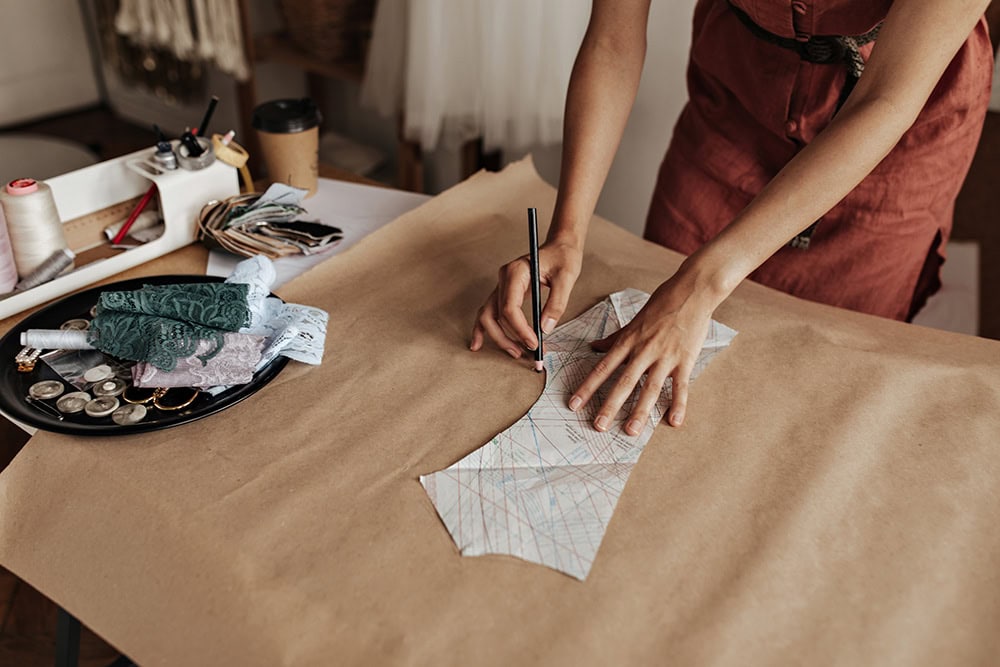
Whilst pattern cutting might not seem like handcraft in the same sense as embroidery, the process of creating patterns for individual clients represents crucial handwork. Andrea Vella Borg emphasises that truly excellent fit requires human judgment – reading how fabric behaves on a particular body, making subtle adjustments that create dramatic improvements.
The Economics of Craftsmanship
Understanding why handcraft has declined in fashion requires acknowledging economic realities. Skilled handwork is time-intensive and therefore expensive. In markets where price often determines purchasing decisions, handcrafted garments struggle to compete.
Andrea Vella Borg acknowledges this challenge, whilst arguing that the cost comparison isn’t quite as straightforward as it appears. A hand-finished garment that lasts decades might actually represent better value than multiple cheap replacements that deteriorate quickly. The calculation depends on how one thinks about clothing – as disposable commodities or as durable goods.
There’s also the question of what skills we choose to value economically. Andrea Vella Borg and his wife have discussed how societies that fail to support traditional crafts through adequate compensation watch those skills disappear within a generation.
Contemporary Designers Championing Craft
Despite industrial fashion’s dominance, certain contemporary designers have built successful practices around traditional techniques and handwork. These designers demonstrate that markets exist for craft-based fashion when quality and value proposition are clearly communicated.
The Slow Fashion Movement
The slow fashion movement, which Andrea Vella Borg follows with interest, explicitly champions craft-based production. Designers within this movement prioritise quality materials, traditional techniques, and fair compensation for skilled workers. They position their garments as alternatives to fast fashion, rather than competing directly on price.
This approach requires different business models – smaller production runs, higher margins, direct relationships with customers who appreciate what they’re purchasing. These designers aren’t trying to clothe millions; they’re creating exceptional garments for clients who value what handcraft provides.
Andrea Vella Borg: Learning to Recognise Quality
For consumers, appreciating handcraft requires developing literacy about quality – learning to see and feel differences between machine and handwork, between adequate and exceptional construction.
Andrea Vella Borg suggests several ways to develop this literacy. Visit workshops or ateliers where skilled craftspeople work, observing techniques firsthand. Examine vintage garments from eras when handwork was standard. Handle fabrics and finished garments mindfully, noting how different construction methods feel.
Indicators of Quality Handwork:
- Buttonholes with visible hand stitching, slightly irregular but perfectly functional
- Internal seams finished cleanly rather than left raw or poorly serged
- Linings attached with visible hand stitching at key points
- Embroidery or embellishment with slight variations showing individual attention
- Overall construction that feels substantial but not stiff, structured but not rigid
The Future of Craft in Fashion
Andrea Vella Borg remains cautiously optimistic about handcraft’s future in fashion. Whilst mass production will continue dominating most of the market, he sees growing appreciation for alternatives among consumers frustrated with fast fashion’s quality and sustainability problems.
Technology might actually support craft rather than replacing it. Digital tools can handle repetitive tasks whilst leaving skilled handwork for areas where human judgment and touch matter most. This hybrid approach could make craft-based production more economically viable.
Education is crucial. Fashion schools that teach traditional techniques alongside digital skills prepare designers to make informed choices about when handwork adds genuine value. Andrea Vella Borg and his wife believe supporting institutions that maintain craft knowledge helps ensure these skills remain available for future generations.
The conversation about craft in fashion ultimately concerns values – what we prioritise, what we’re willing to pay for, how we want clothing to function in our lives. Andrea Vella Borg argues that as awareness grows about fast fashion’s costs, handcraft offers not just an alternative, but potentially a better path forward for fashion’s future.